What does a virtual showroom cost? Options for small shops, compared
A virtual showroom can cost nothing or half a million dollars. Here's what each kind costs in 2026, from free plugins to custom agency builds, the costs people forget, and what makes sense for a small online shop.
“Virtual showroom” covers everything from a free plugin to a flagship 3D experience built by an agency, and the prices are just as wide. If you run a small online shop, the good news is that the cheapest options are now genuinely good.
Where the numbers come from. Plugin and app prices are from their own listings and pricing pages, checked in November 2026. The showroom-platform and custom-build ranges come from a 2026 cost guide by Zolak, which sells showroom software itself. We make Aisleza, one of the options below.
The five ways to get a virtual showroom#
| What you get | Typical cost | Needs 3D models? | |
|---|---|---|---|
| 1. Plugin or app on your shop | A 3D store built from your catalogue, on your own site | Free to a few hundred dollars a year (or month) | Often not |
| 2. Showroom platform (SaaS) | Designed 3D rooms or spaces on a monthly plan | From about $135/month, plus setup and models | Usually |
| 3. 360° tour of a real shop | A photographic walkthrough of your physical store | $750–5,000+ per scan, plus about $20/month hosting | No, but you need a real shop |
| 4. Done-for-you 3D or VR gallery | A gallery built for you, often on the provider's site | Free to install, up to custom quotes | Prepared by the provider |
| 5. Custom-built 3D store | A flagship 3D experience designed for your brand | $50,000–200,000+ | Yes, plus custom 3D design |
1. Plugins and apps: from free#
These add a 3D store to the shop you already have, built from your products. They’re the realistic starting point for most small businesses.
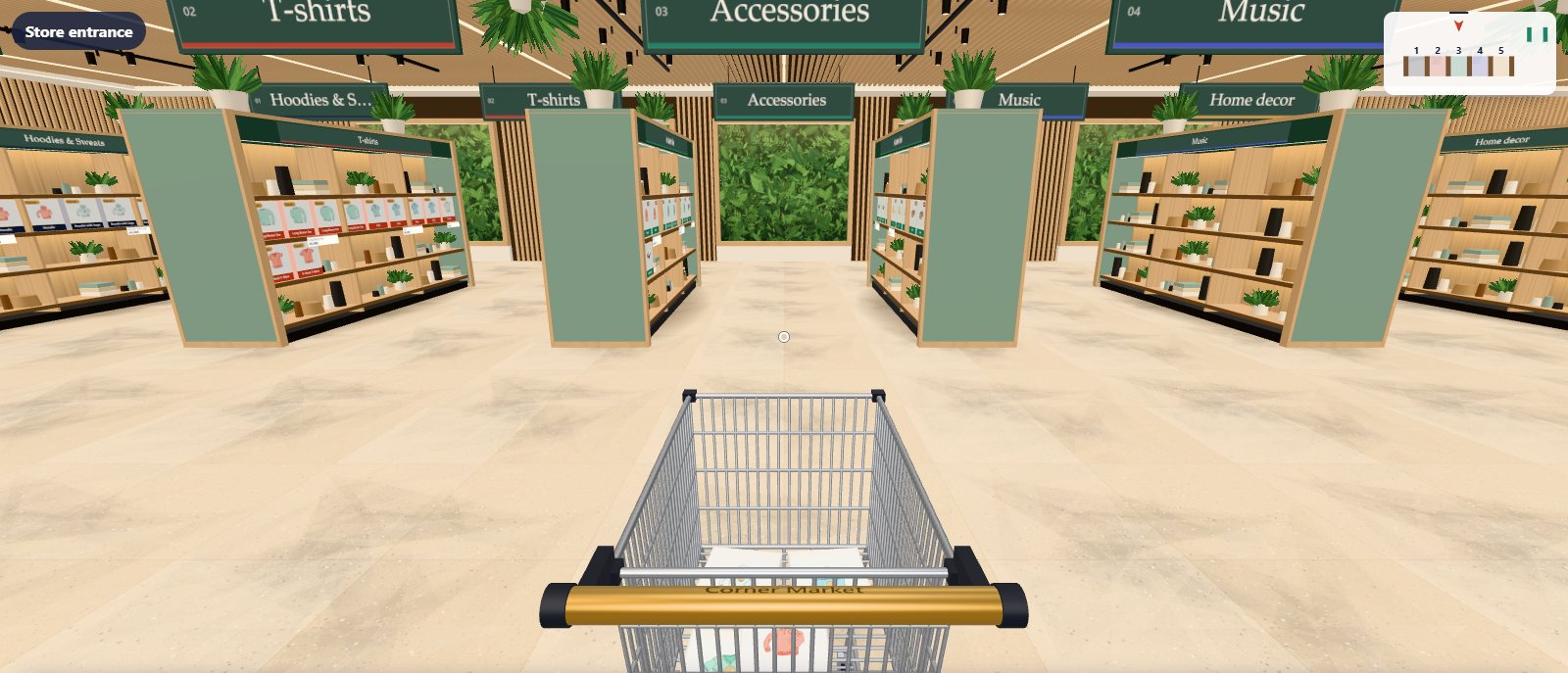
- Aisleza: a walk-in store with your categories as aisles and your real cart. Free for WooCommerce, Magento, PrestaShop, OpenCart and Shopware; Pro from $99 a year or $249 once. On Shopify, Wix and BigCommerce it’s an app with a free plan and paid plans billed by the platform (from $19 a month on Shopify). No 3D models needed.
- WooBaba 3D Gallery: a free 3D gallery corridor for WooCommerce, built from product photos.
- WalkTheWeb: free; your store as a building in WalkTheWeb’s 3D world, with optional paid extras.
- 3D XR Store (Shopify): $19 to $499 a month, built around 3D models; some plans add a 1.5–2% transaction fee and a build cost of $3.75 per square foot, and visits above the plan cost $0.01 each.
For a detailed look at each, see our comparisons for WooCommerce and Shopify.
2. Showroom platforms: from about $135 a month#
Showroom platforms give you designed 3D rooms or spaces on a subscription. They’re popular with furniture and interiors brands, where shoppers want to see a whole room. Zolak’s guide puts entry plans at around $135 a month, with advanced features such as placing furniture in the shopper’s own room from about $525 a month. On top of the subscription come setup, branding and 3D models of your products.
3. 360° tours of a real shop: per scan#
If you already have a beautiful physical shop, a photographic 360° tour lets people visit it online, with hotspots linking to products. Zolak’s guide quotes $750 to $5,000 or more per scan, plus hosting from about $20 a month per space (for example with Matterport). The catch: the tour shows the shop as it was on scan day, so new stock means a new scan.
4. Done-for-you galleries#
Some providers build a 3D or VR gallery for you. Bazaar VR on Shopify, for example, is free to install and hosts your gallery on its own site. Pricing for custom work is usually by quote, so ask what’s included and who owns the result.
5. Custom 3D stores: $50,000 and up#
The flagship experiences you see from big fashion and beauty brands are custom builds: every room, fixture and display designed in 3D. Zolak’s guide puts a custom 3D store in the browser at $50,000 to $200,000 or more, and the most advanced showrooms (with AI room planning) beyond $500,000. Enterprise platforms in this space generally price on request.
The costs people forget#
- 3D models. If an option needs a 3D model of every product, that’s usually priced per model, and it repeats for every new product. For a catalogue of hundreds, this can outweigh everything else.
- Build and design fees. One-off charges to design the space, sometimes priced by size.
- Visit limits. Some plans cap monthly visits and charge for extra ones, which bites when a campaign goes well.
- Transaction fees. A percentage of sales on top of the subscription.
- Keeping it current. New products, seasons and offers: check whether the store updates itself from your catalogue or needs manual work (or a new scan).
What makes sense for a small shop#
For most small online shops, the sensible path is:
- Start with an option built from your catalogue, so there are no 3D models to buy and new products appear automatically. Aisleza’s free plugin is one; on Shopify or Wix, a free app plan.
- Watch how shoppers use it: how many walk in, which aisles they visit, what they add to the trolley. (Aisleza Pro’s shopper insights show exactly this.)
- Spend more only when it’s proven: 3D models for your hero products, custom decor, or a bigger build.
The bottom line: you don't need an agency budget to give shoppers a store to walk into. Try one free on your own products first; it takes about ten minutes. Here's how on WooCommerce, or walk the live demo.
Questions people ask
How much does a virtual showroom cost?
From free to $500,000 or more. Plugins and apps that build a 3D store from your catalogue cost from nothing to a few hundred dollars a year or month; showroom platforms start around $135 a month; custom-built 3D stores typically run $50,000 to $200,000 or more.
What is the cheapest way to get a virtual store?
A plugin or app that builds the store from the products and photos you already have. Aisleza’s free plugin for WooCommerce, for example, costs nothing and needs no 3D models, which are often the biggest hidden cost.
What hidden costs should I watch for?
3D models of your products (usually priced per model), store design or build fees, visit limits and per-visit charges, transaction fees on sales, and scanning costs for a 360° tour of a physical shop.
Is a virtual showroom worth it for a small business?
It can be, if it costs little to try. Start with a low-cost option built from your existing catalogue, watch how shoppers use it, and only invest in custom 3D work once you know it helps your sales.
More guides
- Virtual showroom software that builds itself from your catalogMost virtual showroom software asks for 3D models, a design project and a monthly fee before a single shopper walks in. Here's what to look …
- The best 3D virtual store plugins for WooCommerce in 2026Want shoppers to walk through your WooCommerce shop in 3D? Here is every plugin that does it today, what each one is really like, and which …
- Shopify virtual store apps comparedLooking for a 3D or virtual store app for Shopify? Several well-known names have left the App Store, and the ones that remain work in very …
- 3D product viewer vs 3D virtual store: which does your shop need?Both get called "3D for your online shop", but they do very different jobs. One lets shoppers spin a single product; the other lets them …
- How to add a 3D virtual store to your WooCommerce shopA step-by-step guide to turning your WooCommerce shop into a 3D store shoppers walk through, using your existing products and photos. It …
 Ready when you are
Give your shoppers
somewhere to go
Start free with the walk-in store. Add Pro for every skin, Ava, camera views and merchandising.